
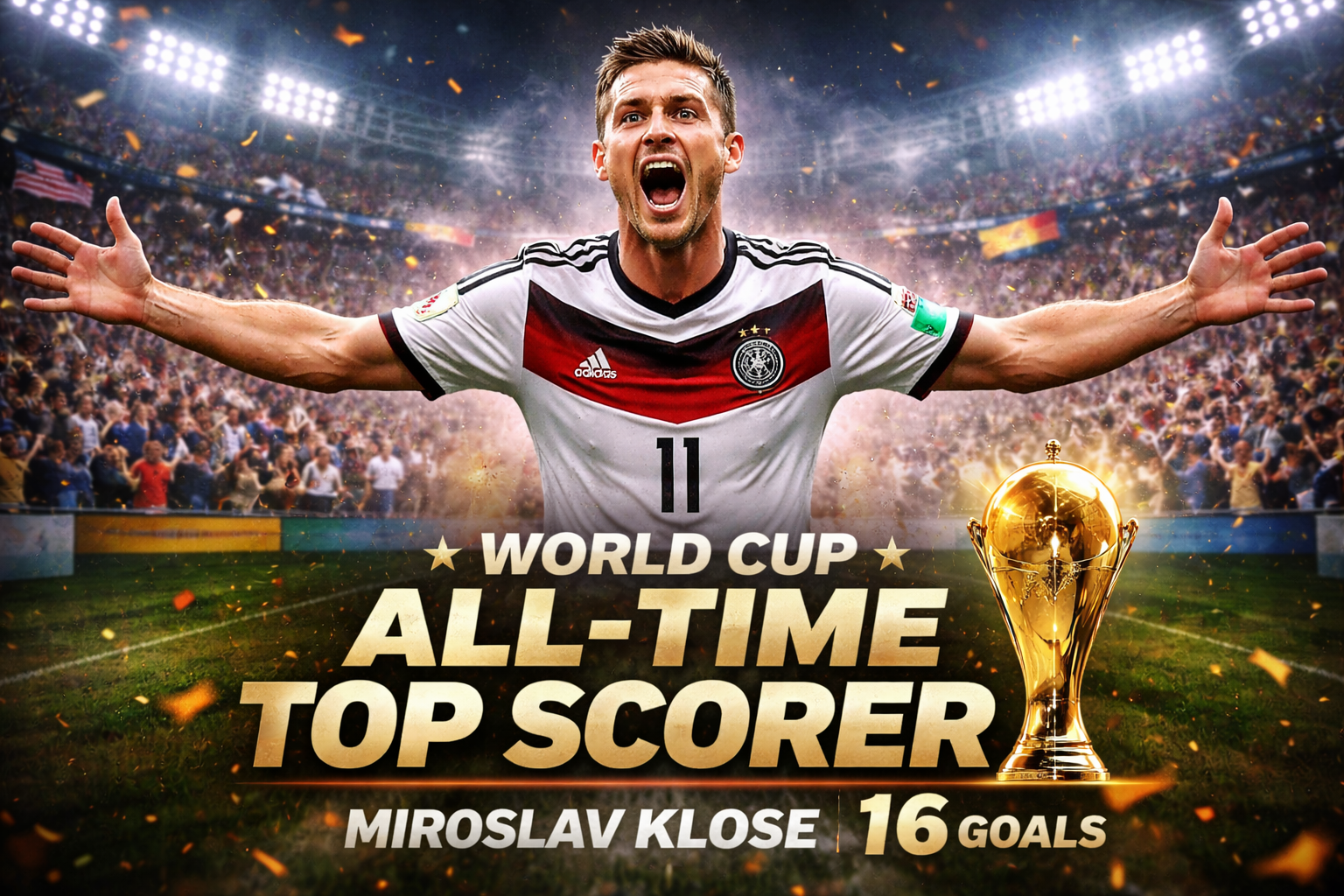
The FIFA World Cup is the biggest stage in football. Every four years, the world watches as legends are born, dreams are shattered, and history is written. Goals scored at the World Cup carry a different weight — they define careers, shape nations, and live forever in the memory of fans.
Many legendary players have left their mark on the tournament, from Pelé to Ronaldo, from Gerd Müller to Lionel Messi. But when it comes to one simple, undeniable question — who scored the most goals in World Cup history? — there is only one correct answer.
The greatest goal scorer in World Cup history is Miroslav Klose.
This article explores how Klose achieved this historic record, why his achievement is so extraordinary, and why his legacy deserves far more respect than it often receives.
The Official Record: Goals That Changed World Cup History
Miroslav Klose holds the record for the most goals ever scored in FIFA World Cup tournaments, with 16 goals.
He achieved this across four World Cups:
- 2002 (South Korea & Japan)
- 2006 (Germany)
- 2010 (South Africa)
- 2014 (Brazil)
What makes this record remarkable is not just the number, but the consistency. Klose scored in every World Cup he played, a feat that very few players in history can claim.
He broke the previous record of 15 goals, held by Brazilian legend Ronaldo, during the 2014 World Cup in Brazil. That goal came against the host nation in a historic 7–1 semifinal victory — a moment forever etched into football history.
Unlike many goal scorers, Klose was never known for flashy skills or superstar marketing. His greatness came from intelligence, positioning, discipline, and relentless efficiency.
Consistency Over Brilliance: Why Klose Was Different
Miroslav Klose was not the most technically gifted striker of his generation. He was not the fastest, strongest, or most creative. Yet, when it mattered most, he delivered.
His playing style was based on:
- Exceptional positioning inside the box
- Intelligent movement off the ball
- Clinical finishing with both feet and his head
- Tactical discipline and teamwork
Klose scored goals in knockout matches, group stages, semifinals, and finals. He was reliable under pressure — something many more “talented” players struggled with.
In a tournament as unforgiving as the World Cup, brilliance can shine briefly. Consistency, however, creates legends. That is where Klose separated himself from everyone else.
World Cup Pressure: Why This Record Is Almost Impossible to Break
Scoring goals in domestic leagues is difficult. Scoring goals in continental competitions is harder. Scoring goals at the World Cup is the ultimate challenge.
The FIFA World Cup offers:
- Fewer matches
- Stronger opponents
- Extreme psychological pressure
- Tactical caution from teams
To score 16 goals, a player must not only be elite, but also:
- Qualify for multiple World Cups
- Stay healthy over more than a decade
- Play for a competitive national team
- Deliver at the highest level consistently
Many modern stars struggle to play in even two or three World Cups. Klose played four — and remained effective in all of them.
That is why football experts believe his record may stand for generations.
Why Miroslav Klose Is Often Underrated
Despite his record, Miroslav Klose is frequently overlooked in debates about football’s greatest players. This says more about modern football culture than about Klose himself.
He never chased individual awards.
He never demanded attention.
He never built a controversial public image.
Instead, he focused on the team.
Klose won the World Cup in 2014, finished third twice, and second once. His international career was built on professionalism, humility, and respect — values that are less celebrated in an era obsessed with social media presence and personal branding.
Yet, history is not written by marketing. It is written by facts. And the fact is simple: no one has scored more World Cup goals than Miroslav Klose.
Can Anyone Break the Record?
This question is asked every World Cup cycle — and the answer remains unclear.
Modern football presents new challenges:
- Increased physical demands
- More defensive tactics
- Shorter international careers
- Fewer World Cups per player
Even the biggest stars of today face enormous obstacles. To break Klose’s record, a player would likely need:
- At least four World Cups
- A minimum of 4 goals per tournament
- A consistently strong national team
So far, no active player is clearly on track to surpass 16 goals.
That doesn’t mean it will never happen — but it shows just how extraordinary Klose’s achievement truly is.
Final Thoughts: A Record That Defines World Cup Greatness
Football history is full of debates. Who was the best? Who was the most talented? Who was the most influential?
But when it comes to the World Cup’s greatest goal scorer, there is no debate.
Miroslav Klose didn’t just break a record — he set a standard for consistency, professionalism, and excellence on the biggest stage in sport.
Long after goals are forgotten and tournaments fade into memory, one number will remain untouchable:
16 goals. One legend. One World Cup king.








Leave a Reply